Inside the Computer Room
Village Telecentres as Archives of the Global History of the Internet
Source profile
Photos of a computer room in Chandauli, Mewat region of Rajasthan, India- Date
- 2011-2015
- Archive
- Sandeep Mertia private
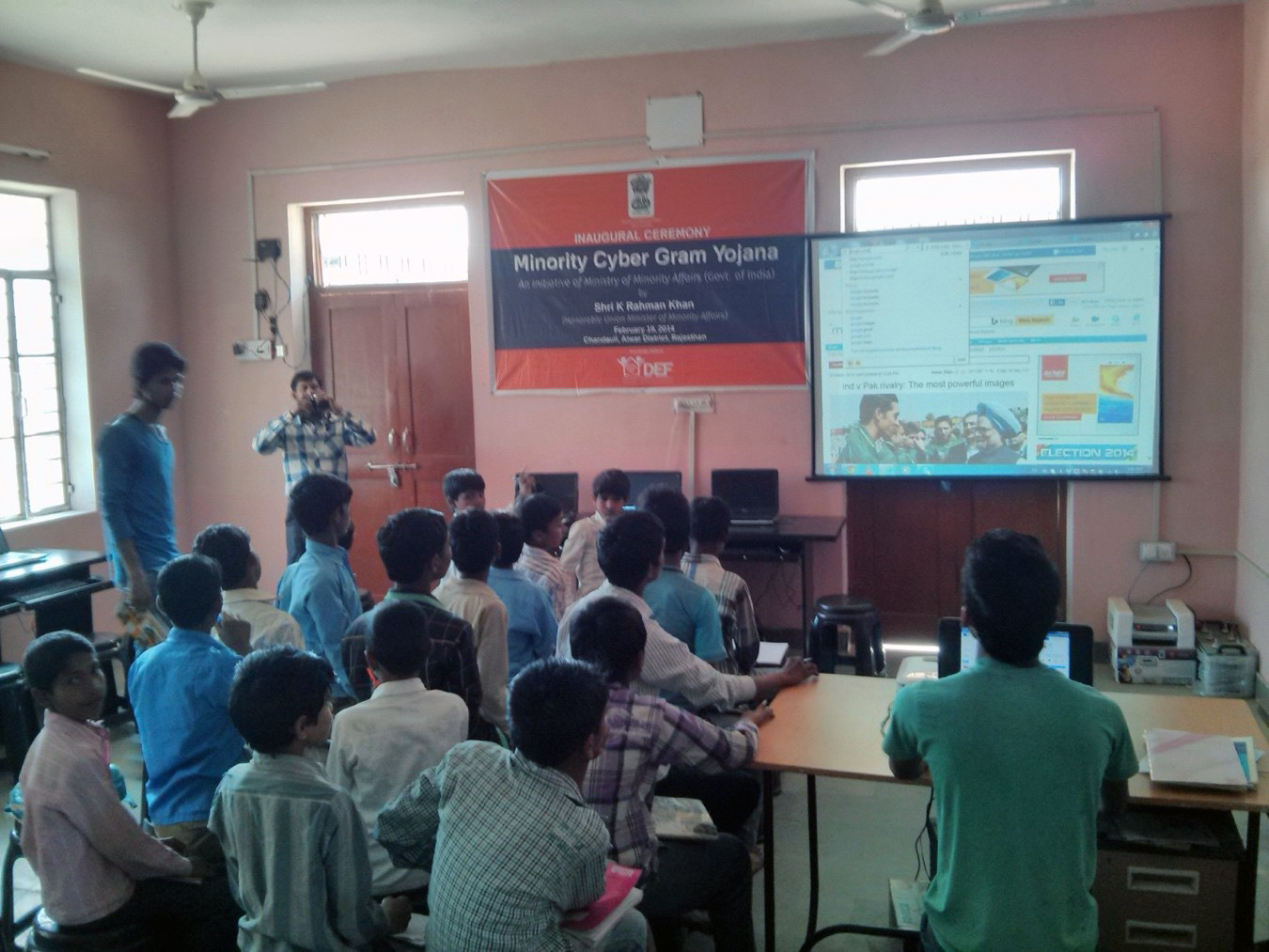
In a computer room in Chandauli, a village near Alwar in the Mewat region of Rajasthan, twenty-five laptops were laid out for the children of the country’s only »Minority Cyber Gram« (Minority Cyber Village) – a pilot of the Ministry of Minority Affairs, in partnership with a non-profit organization, Digital Empowerment Foundation.1 As part of my ethnography of ICT4D (Information and Communication Technologies for Development) and e-Governance projects, between 2011 and 2015, I first spent time in that room in March 2014 (see Figure 1), watching school children open their first Facebook and Google accounts; many were girls, and by the volunteers’ account, they were outpacing the boys.2 Several added me as a friend on Facebook, and a few still surface in my feed and inbox.
Later that year, in October, Mark Zuckerberg visited the same room. The Hindi press called him the Facebook janamdata (the platform’s creator), who arrived to play teacher at the cyber village, to showcase the power of his platform’s global reach. He later used the village’s example to campaign for »Free Basics« (then called internet.org) – a free suite of select internet services by Facebook promising a »first step towards digital equality«, which attracted a spirited public protest and government action for violating basic net neutrality principles.3
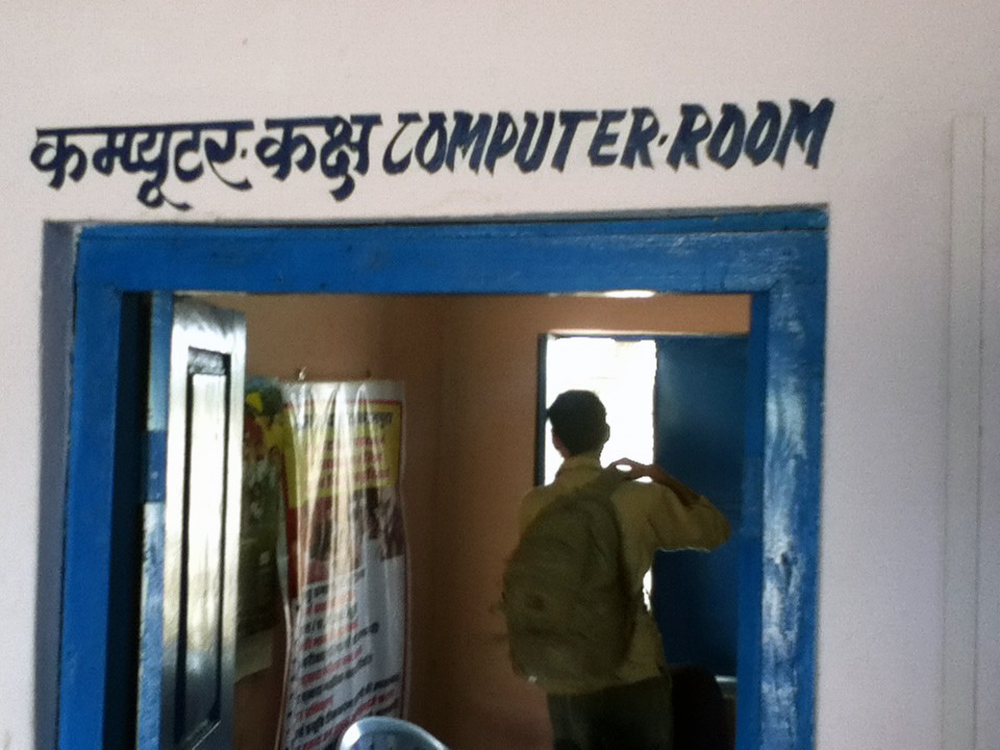
Nine months earlier and three hundred kilometers to the south-west, in the Ajmer district of Rajasthan, I had been standing in another room like this. Above its blue doorframe were two hand-painted inscriptions named it in two scripts: कम्प्यूटर कक्ष and COMPUTER ROOM (Figure 2).
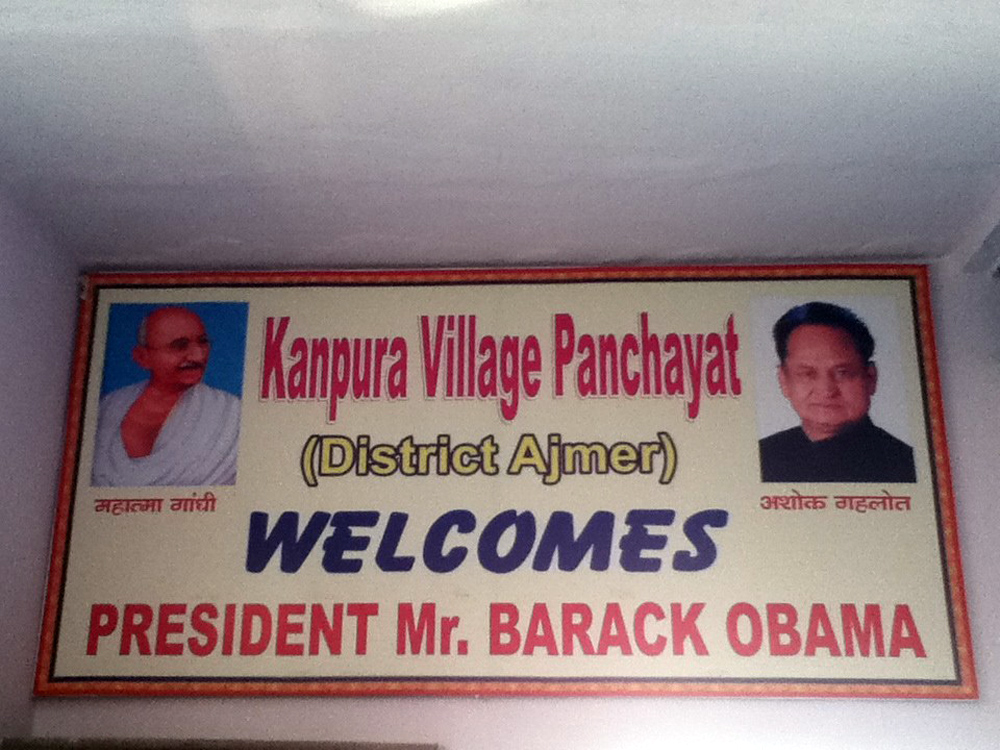
This was the panchayat building of Kanpura, a village with a population of about 2,500. On paper, this computer room was among the best-connected spaces in rural India – a node on a government optical-fiber pilot project, served by a 100 Mbps line that, at the time, only select metropolitan centers in India could match. A banner hung on the wall, its colors had barely faded: »Kanpura Village Panchayat (District Ajmer) WELCOMES PRESIDENT Mr. BARACK OBAMA«, flanked by Gandhi and the chief minister of Rajasthan (Figure 3).
In November 2010, a five-minute video conference connected the US president, who was on a state visit to Mumbai at this time, with a group assembled in this room, who reported that they had received test results and land records online.4 Obama predicted the village would become »a model for countries around the world.«5 Officials had choreographed the phone call down to its participants – the farmer who praised the land records was himself connected to the panchayat – and it addressed the world rather than the village; most residents learned of their fame secondhand.
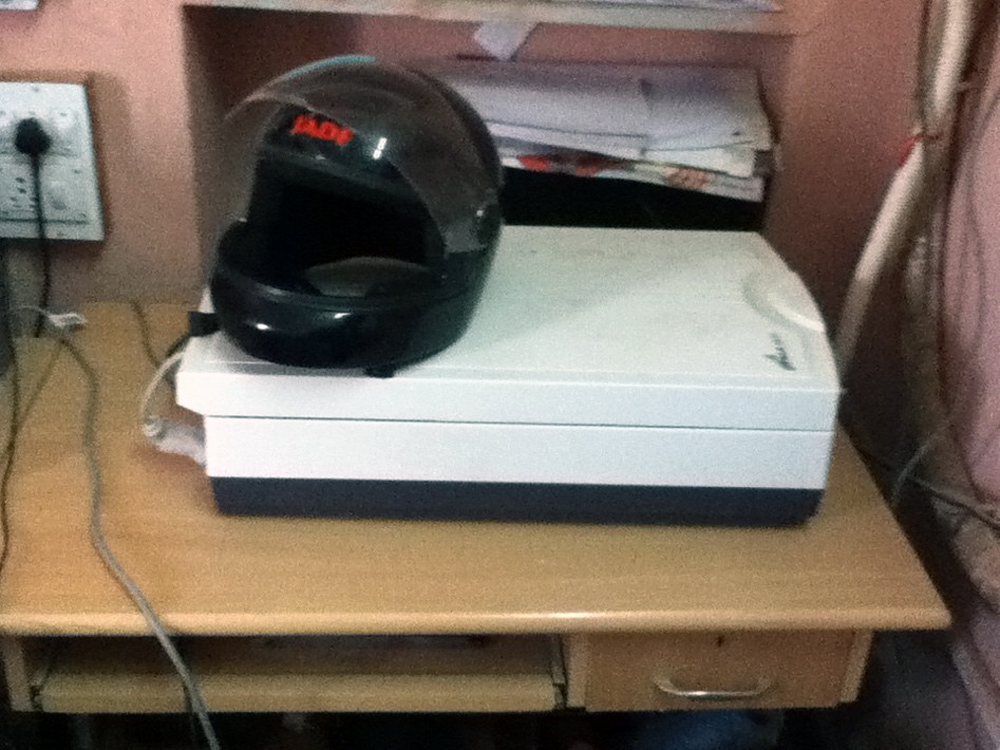
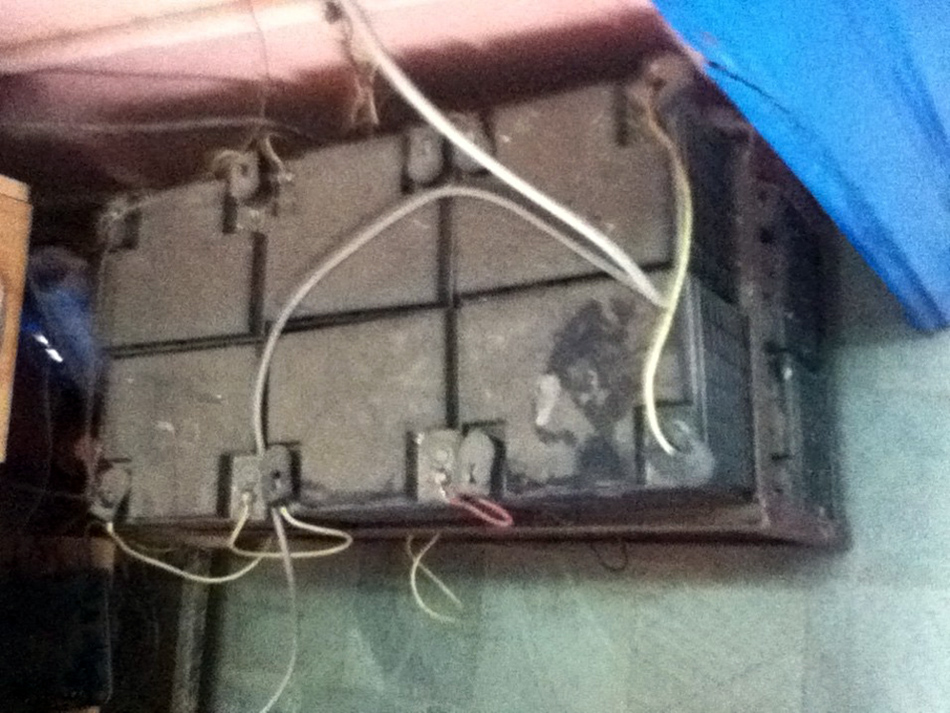
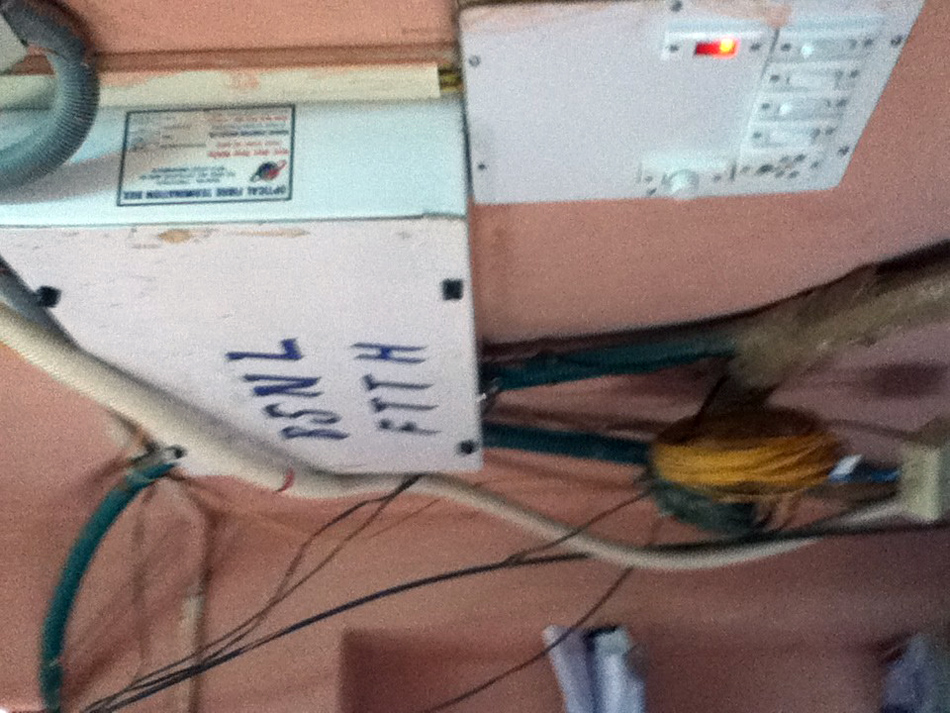
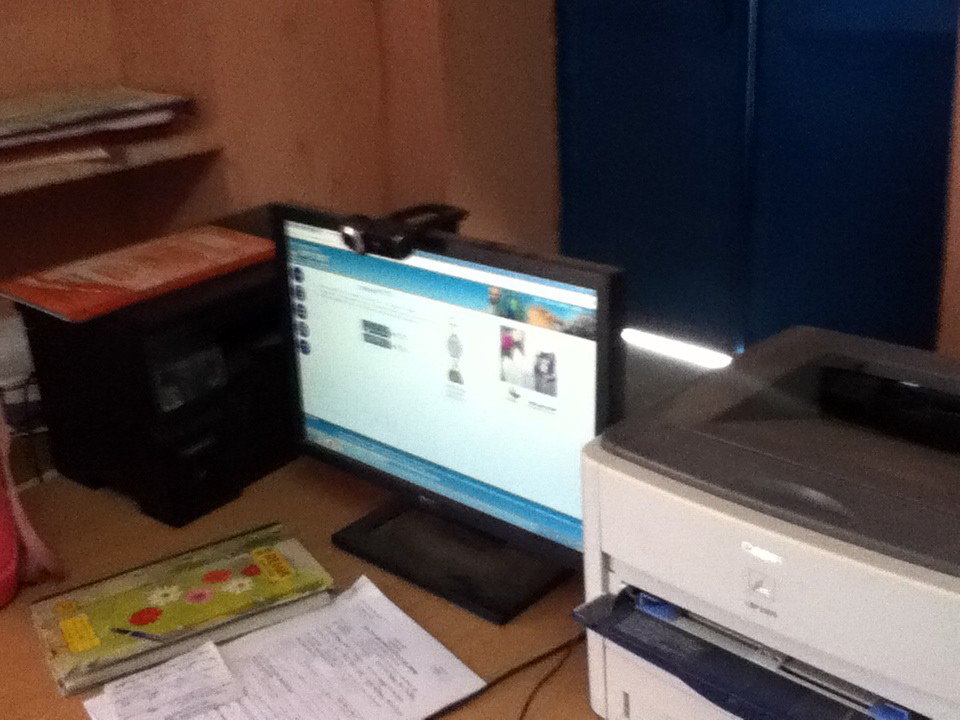
What the cameras did not record is what the room looked like on an ordinary day. A few steps away from the banner, the telecentre’s operator – a young man who commuted daily from Ajmer city – sat at the government terminal with Facebook open on the screen, a webcam clipped to the monitor, chatting with operators in nearby villages. On a side table, a flatbed scanner served as a shelf for his motorcycle helmet (Figure 4). Underneath, a bank of inverter batteries sat under a thick coat of dust (Figure 5), stored electricity against a grid that failed without notice; nearby, the slack yellow coil of the BSNL fiber terminated in a tangle of improvised wiring (Figure 6).
Such local improvisations of infrastructure – enfolding rituals, hacks, and appropriations of intended instrumental use – are a routine feature of technological life in India and the global South at large.6 Despite the scale of publicity of the event, I found that nearly half the village – particularly the caste groups that did not vote for the village head (sarpanch) – did not know the project existed. The handful of regular users were almost all upper-caste men tied to the sarpanch’s network. The Dalit and lower caste families on the village’s margins, along with nearly all its women, never crossed the threshold of access. The optical fiber for internet connectivity had arrived, but access to it ran along the same lines of caste, gender, and patronage that governed everything else in the village. The banner welcoming Obama, it turned out, was the project’s most durable output.
Two of the most powerful figures of the early digital age had each been received in a village computer room as proof of a new technological future of rural development and global connectivity.7 This essay treats those rooms as archives and asks what kind of histories of computing they store, and how they index the digital mediation of wide-ranging structural inequalities in a postcolonial and global South context.
The Rural Internet’s Form
Between roughly the late 1990s and the mid-2010s – after the public internet arrived, before the smartphone made it personal and portable – the village telecentre was the form through which states and development agencies imagined delivering the digital age to the rural majority in India and across the global South.8 It travelled the world under many names: ITU and World Bank kiosks, Hungarian telecottages, South African multipurpose community centers, and Indonesian Desa Broadband Terpadu, among others. India alone planned more than 100,000 Common Service Centres under its National e-Governance Plan in 2006, and the acronyms multiplied locally – CSC (Common Service Centers), e-Mitra centers (»electronic friend« centers that deliver government services),9 GP-NIC (Gram Panchayat – National Informatics Center), DKC (Digital Knowledge Center), NOFN (National Optical Fiber Network) – each a slightly different dream of the same room.10 Kanpura’s fiber was a »proof-of-concept« pilot, and thirty kilometers away, Arian hosted one of only three National Optical Fiber Network sites in the country.
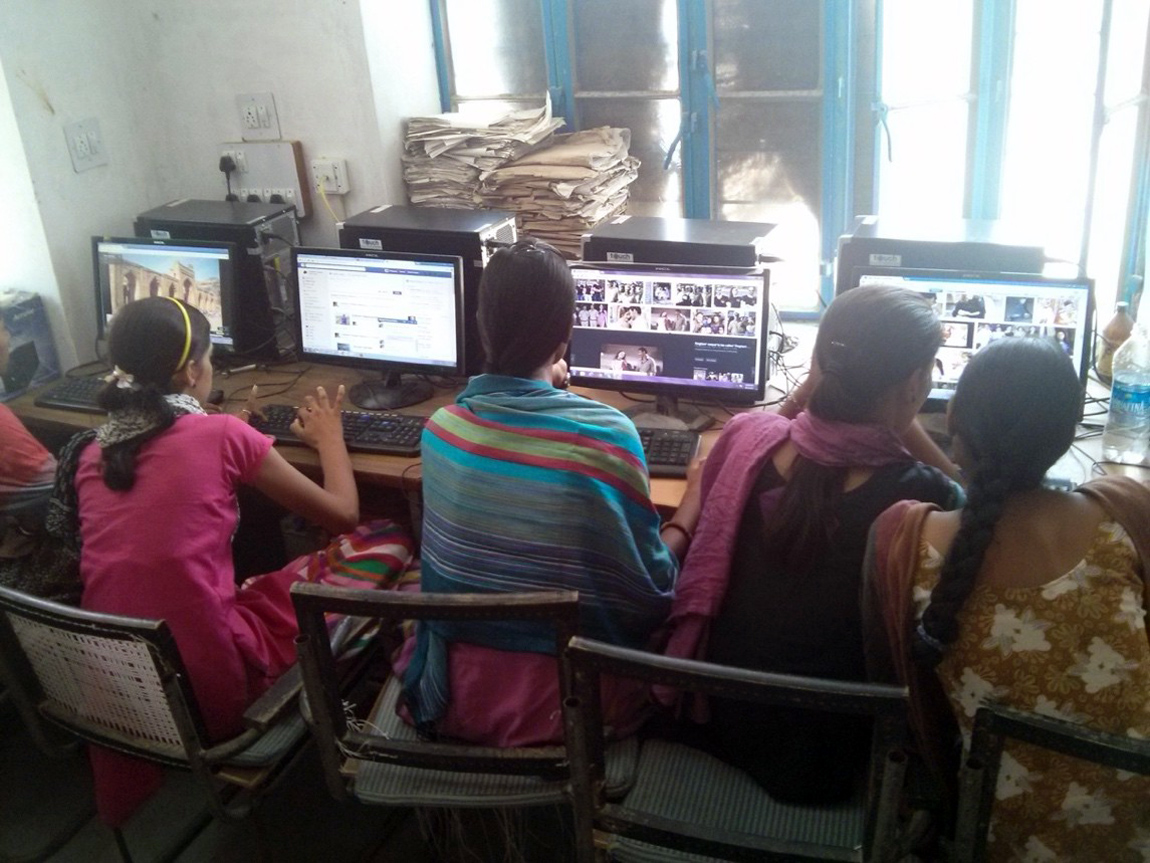
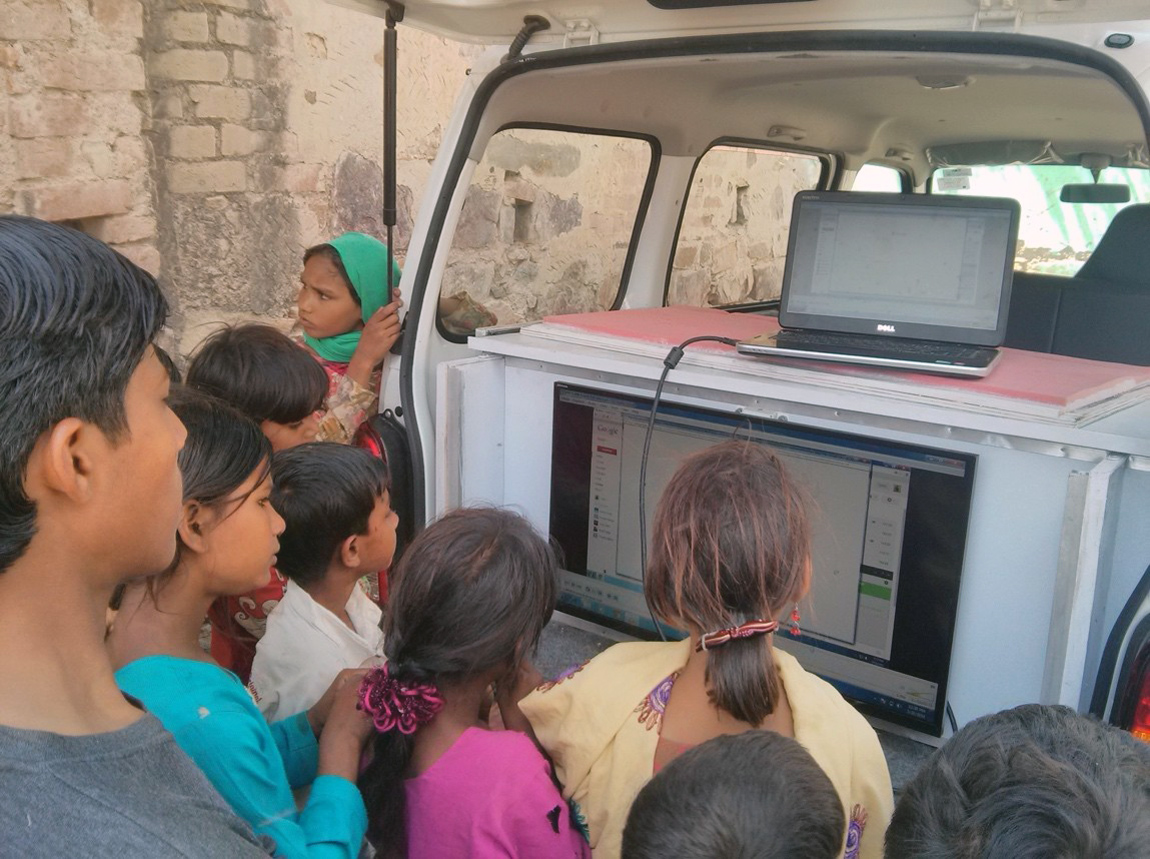
Of the many shapes that the rapidly evolving form of the rural internet took in these sites, I recall three critical archival ones here: the embedded gram panchayat (village government) state office (Figures 2-6), like Kanpura’s; the improvised classroom, with dedicated daily »digital literacy«11 classes for school children like in Arian (Figure 7) and Chandauli (Figure 1); and the roving demonstration – a »Digi-Van« that drove computer-literacy modules into Mewat’s villages, children crowding its open tailgate to watch a screen the way an earlier generation had watched travelling cinema (Figure 8).
Each of these projects promised digital connectivity to the villages, both spatially to the world and temporally to the dominant imaginaries of technological modernity. While these projects were explicitly aimed at bridging the »digital divide« between rural India and national and global technological hubs, the uneven and often unexpected adoption and access practices on the ground revealed layered forms of digital mediation of existing inequalities in terms of skills, usage patterns, and development outcomes.12 Who learned to use the computer and who only watched, whose certificate the land-record portal could actually produce and who was asked to travel to the city to get a copy – these were not questions of a binary technological divide but of caste, class, and gender, intersecting and graded. Revisiting the spatial form of rural internet in/from telecenters helps not only to expand the geography of the history of the internet, but also the lived experience of those who are relegated to the margins of the global digital economy.
Whose Archive?
Telecenters have been one of the most documented experiments of ICT4D, from policy evaluations to critical scholarship on e-governance projects, including ethnographies – my own among them. Yet, telecenters are now largely sedimented under a smartphone-driven digital future. The record is split across archives that preserve different things, answer to different interests, and do not speak to one another.
First is the state’s own official information ecosystem of press releases, award certificates, the Obama footage, the Zuckerberg visit, and the banner still hanging many years on. Though fragmented across news media, government reports, and social media posts, it is the best-preserved layer precisely because it was built to be seen – and the most invested in the promise rather than its outcome. The techno-developmentalist state has since pivoted to a plethora of e-governance mobile apps and Digital Public Infrastructures such as Aadhaar biometric identity and digital payments, burying the record of its formerly imagined future of rural broadband connectivity under the purported ubiquity of mobile phones.
The second archive is the scholarly and ethnographic record, including the field notes and several thousand photographs I took, some of which I’m sharing here. This record can be read as an evolving material and epistemological interface between history and anthropology, particularly in the pluralization of the genealogies and socio-technical relations of contemporary infrastructures in a postcolonial context.13 The ethnographic study here registers what the first, official archival set leaves out: the empty usage register at a telecenter in which not a single woman appeared, a gendered and caste-based exclusion the project never addressed; the dust; the operators, posted alone across ten panchayats, who kept a running video chat among themselves and used the fast official line for the same things anyone would.
This ethnographic archive survives only because researchers like me happened to be there, and it carries the marks of its own making. Every image in this essay was taken on a basic Android phone. I did not own a smartphone with a high-resolution camera until 2016. The blur in a photograph of an e-governance portal I can no longer identify is not incidental (Figure 9) – it is the resolution of my own position in the very hierarchy of devices I had come to study. The operator at his government computer, the schoolgirls on shared GPRS handsets, and I, an urbanite, male, upper-caste (Jain),14 engineering student-researcher with his entry-level smartphone – three rungs of one ladder, and the photographs are the trace of the photographer’s rung. In contrast, in Chandauli, an NGO issued its volunteers high-end cameras to record their success; we were photographing the same room from different places in the economy of the digital age.
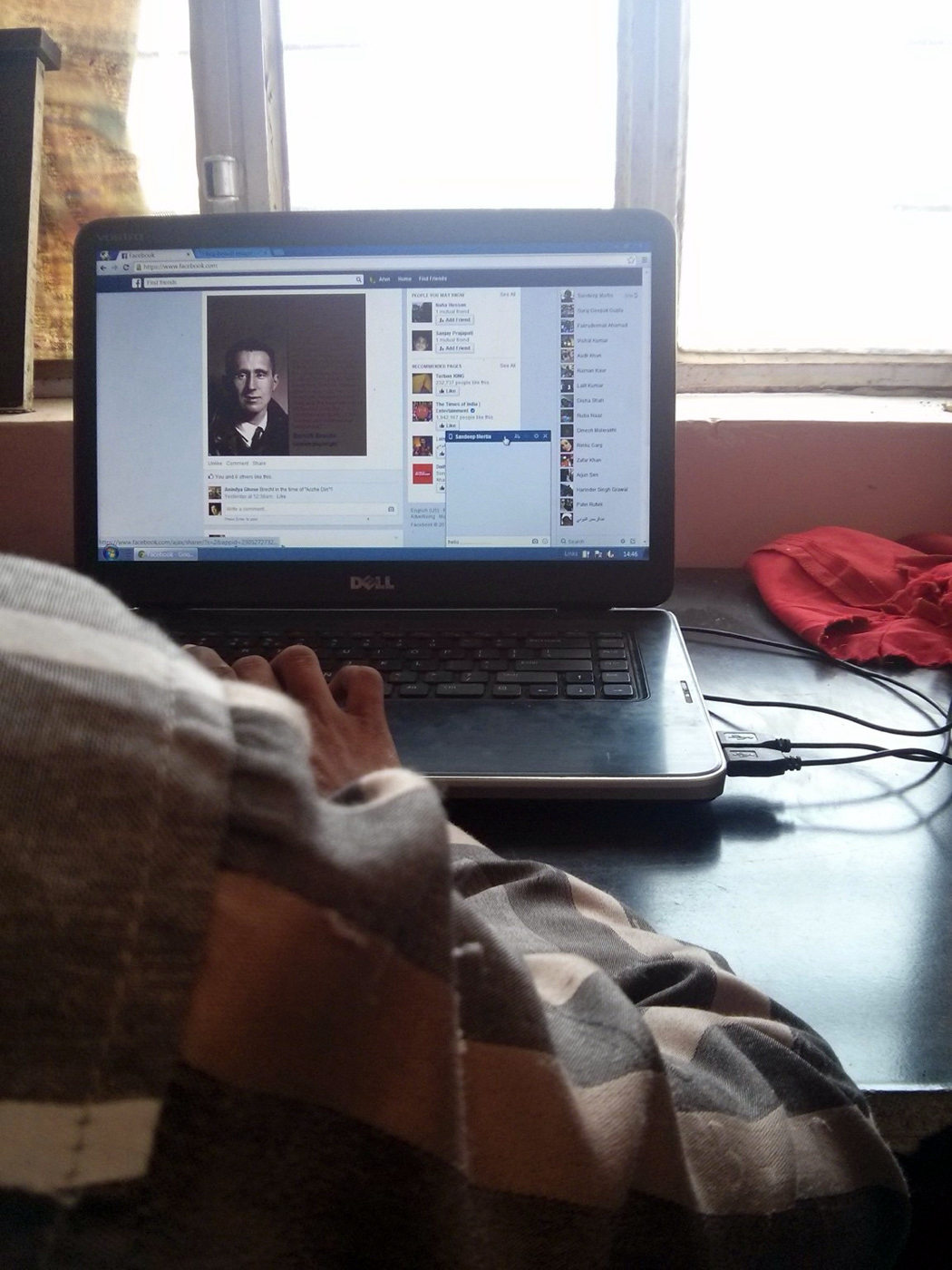
The third archive lives on the internet itself – the Facebook accounts, search histories, and shared media that the telecentre’s users actually produced. It is the richest record of how these rooms were lived in, and the least accessible, privately held, and monetised, far from the villages that made it. When the children of Chandauli friended me on Facebook, they enrolled our encounter in an archive owned by the man who visited their classroom that October, and marketed their data and life experience as evidence for his platform’s universal appeal. I am inside it too – searchable, dislocated in the data flows, unable to retrieve it (Figure 10).
The Ruin and the Road
Walk the room again from the vantage point of 2026, and the archival strata sort themselves out. The banner is the spectacle. The Facebook screen is the life that actually happened there – what people called timepass, the unhurried, sociable use of a machine the state had installed for something else.15 And the dust is the ruin: inverter batteries on standby against an unreliable grid, a slack coil of optical fiber ending in a tangle of wire on a pink wall, paper files stacked beside the terminals as the older bureaucracy quietly outlasted the new one.
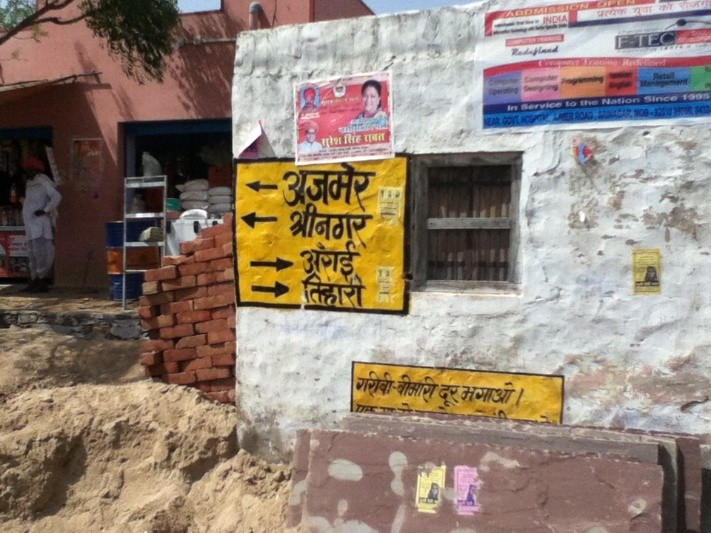
The lesson of the ruin is that the missing layer of the »last mile« was never bandwidth alone, but also electricity. When the power or the line failed, the classrooms emptied within an hour. Step out of the doorway and another future is already arriving by another road. On a wall at the village crossroads, hand-painted directions to Ajmer and Srinagar share the plaster with an advertisement for a private computer-training institute declaring, »In Service to the Nation Since 1995«, alongside a politician’s poster and a government slogan about eradicating poverty and hunger that is partially covered by construction materials (Figure 11). The state’s pilot gathered dust a few hundred meters away, it was the market’s device, the cheap smartphone, that would reach further into the village than the computer room ever did.
This was a change of paradigm, not the arrival of the ICT4D promise. The telecentre model of ICT4D and e-governance gave way to another: the personal smartphone, paired with Aadhaar’s biometric identity, the digital public infrastructure built atop it, and welfare paid by direct benefits transfer. Neither paradigm has ever been total. Many telecenters still operate, and the optical fiber promised to every village remains, a decade on, unfinished across vast stretches of the country. The headline figure of close to a billion people online is inflated by elites and the middle class holding several devices and connections at once, with only about a third of Indian women using the internet, and rural home broadband connectivity still in single-digit percentages. The same rural, female, lower-caste, and poor users who were last to learn about or access the computer room remain last in line for meaningful access today, now beneath a statistical surface that counts having a SIM card and a biometric identity card as inclusion. The promise that these spaces were built to embody – universal connectivity, the village »catching up« with the world – has been kept by neither paradigm, only deferred and remediated.
In my view, that’s the most important sociotechnical insight that the computer room as an archive offers: not a failure to explain away, but a promissory future still outstanding, now overlaid by newer ones centered on smartphones, apps, and platforms. Its most honest document may be the smallest: The schoolchildren who opened accounts made them by the handful and forgot the passwords without anxiety, then made new ones – a relationship to digital identity as plural and disposable as the new regime of singular, permanent, biometric identity is not. Abandonment was their own oblique form of record-keeping. To write the global history of the internet from a place like this is to read that record alongside the banner and the dust, to take the unfinished promise as seriously as the spectacle that first announced it, and finally, to keep asking, of every new digital future, whose lived experience enters the archive and on what terms.
Footnotes
-
1
See, Minority Cyber Gram Yojana, Digital Empowerment Foundation, 2014, https://defindia.org/minority-cyber-gram-yojana/.
-
2
My research on rural e-governance and ICT4D projects began in 2011 with exploratory fieldwork on biometric ration cards in Banaskantha, Gujarat, as part of a Science, Technology, and Society (STS) course project under the guidance of Prof. Madhumita Mazumdar during the second year of engineering undergraduate program at Dhirubhai Ambani University, Gandhinagar. Subsequently, I focused on rural internet projects in my home state of Rajasthan for my summer research internship in 2013 and the BTech thesis project in 2014, under the guidance of Prof. Mazumdar and Prof. Visvajit Pandya. Upon graduation, I received the inaugural Sarai-CSDS Social and Digital Media Research Fellowship (May – November 2014) to further explore rural internet cultures in Rajasthan. To learn more about these projects see, Sandeep Mertia, Understanding Rural Techno-Culture and Social Media, in: Sarai, 2014, https://sarai.net/understanding-rural-techno-culture-and-social-media/; idem, Exploring the Caste, Gender & Politics of Technology – An Ethnographic Enquiry into e-Governance in Rural Rajasthan, in: Research Committee on Science, Technology & Society (RC-13), 39th All India Sociological Conference, Mysore, 27-29 December 2013, https://www.academia.edu/5583559/Exploring_the_Caste_Gender_and_Politics_of_Technology_An_Ethnographic_Enquiry_into_e_Governance_in_Rural_Rajasthan.
-
3
See, Rahul Bhatia, The Inside Story of Facebook’s biggest setback, in: Guardian, 12 May 2016, https://www.theguardian.com/technology/2016/may/12/facebook-free-basics-india-zuckerberg.
-
4
See NDTV,. Rajasthan village excited to meet Obama, 8 November 2010, in: YouTube, https://www.youtube.com/watch?v=ooBbU8j4hJQ.
-
5
See The Hindu, IT Revolution in Rajasthan Village Impresses Obama, 8 November 2010, https://www.thehindu.com/news/national/other-states/IT-revolution-in-Rajasthan-village-impresses-Obama/article15678446.ece.
-
6
See Sundar Sarukkai, Culture of Technology and ICTs, in: Ashwani Saith/M. Vijayabaskar/V. Gayathri (eds.), ICTs and Indian Social Change: Diffusion, Poverty, Governance, New Delhi 2008 , pp. 34-58.
-
7
Previous iterations of such techno-developmentalist futures in rural India and the global South at large include radio, television, documentary cinema, and telephone connectivity-based communication technologies. See Ashish Rajadhyaksha, The Last Cultural Mile: An Inquiry into Technology and Governance in India, Bangalore 2011, Centre for Internet and Society, https://cis-india.org/raw/histories-of-the-internet/last-cultural-mile.pdf.
-
8
Beyond the convergence around the spatial form of the telecenters in most of the world, there are a wide range of physical devices and software and content design across ICT4D projects, from the “Hole in the Wall” experiment in Delhi in 1999 to large-scale initiatives such as the One Laptop Per Child (OLPC) in mid-2000s, and India’s »Simputer« to Brazil’s »computador popular« (people’s computer). See Mark Warschauer, Technology and Social Inclusion: Rethinking the Digital Divide, Cambridge, MA 2003, https://direct.mit.edu/books/oa-monograph/1817/Technology-and-Social-InclusionRethinking-the; Morgan G. Ames, The Charisma Machine: The Life, Death, and Legacy of One Laptop per Child. Cambridge, MA 2019.
-
9
See e-Mitra, Government of Rajasthan, https://emitra.rajasthan.gov.in/emitra/about.
-
10
See Mukerji Maitrayee, ICTs and Development: A Study of Telecentres in Rural India, London 2013.
-
11
For an earlier iteration of computer literacy in school education in India see the 1984 report by the National Council of Education, Research and Training on CLASS (Computer Literacy and Studies in School), https://archive.org/details/dli.ernet.18885/mode/2up.
-
12
For a history of critique of »digital divide«, see Paul DiMaggio/Eszter Hargittai, From the »Digital Divide« to »Digital Inequality«: Studying Internet Use as Penetration Increases, Working Paper #47, Center for Arts and Cultural Policy Studies, Princeton University 2001, https://ideas.repec.org/p/pri/cpanda/15.html#author-abstract.
-
13
It is worth noting that historical anthropology as a sub-field developed in the works of Bernard Cohn and Ann Stoler, to name but two, as a direct response to the limits of conventional historiographical research for understanding colonialism and its living legacies. Contemporary conversations between history and anthropology in postcolonial contexts are increasingly gravitating towards media infrastructures that remediate colonial legacies even as they engender new forms of circulation of images, data, affect, and value. See Debjani Bhattacharyya/Nils Güttler/Lena Kaufmann/Brian Larkin, »Forms of Mixing«: Contemporary History and Sociocultural Anthropology. A Conversation with Debjani Bhattacharyya and Brian Larkin, in: Zeithistorische Forschungen/Studies in Contemporary History, Online-Ausgabe, 21 (2024-2025), H. 1, https://zeithistorische-forschungen.de/1-2024-2025/6200, S. 139-154. See also Sandeep Mertia, Did Mahalanobis Dream of Androids?, in: id. (ed.), Lives of Data: Essays on Computational Cultures from India, pp. 26-33, Institute of Network Cultures 2020, https://research.hva.nl/en/publications/lives-of-data-essays-on-computational-cultures-from-india/.
-
14
For readers unfamiliar with Indian history: Jainism is a separate, minority religion, and a contemporary of Buddhism, with a history of anti-caste-based movement away from Vedic Hinduism. However, in modern India, Jains are considered to be upper caste merchants and among the most active practitioners of caste-based purity practices around food.
-
15
See Sandeep Mertia, »Timepass« Development: Situating Social Media in Rural Rajasthan, in: Economic and Political Weekly 52 (2017), no. 47, pp. 69-76 (https://www.jstor.org/stable/26697896).
License