Picturing the Digital Age in South Africa
Newspaper Archives and their Visual Heritage
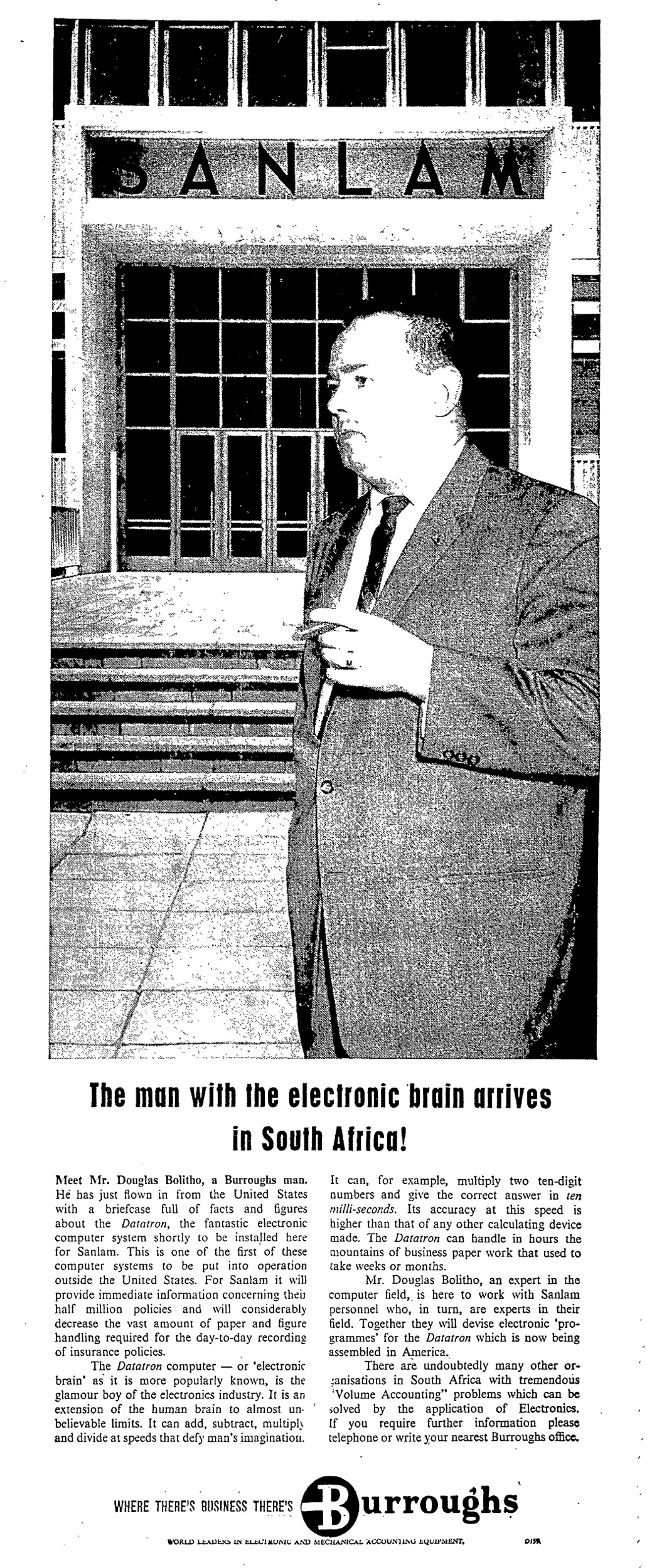
In 1958, the US computer company Burroughs published a notable advertisement for its new Datatron computer in the South African Newspaper Rand Daily Mail. According to the ad, the new computer technology would be used to keep track of the South African Life Assurance Company’s »half million policies« and would »considerably decrease the vast amount of paper and figure handling required for the day-to-day recording of insurance policies.« It was purportedly »one of the first of these computer systems to be put into operation outside the United States.« The computer was being assembled in the US and would be programmed in South Africa with the help of Mr Douglas Bolitho, portrayed in the ad. Bolitho, known for programming, stands pensively in front of the SANLAM headquarters in Cape Town in a dark suit and holding a cigar, highlighting the individualised (male) expert knowledge coming from overseas, and simultaneously, the imminent incorporation of it into the local company. In the same year, IBM marketed one of its first computers in South Africa.1
Steckbrief Quelle
South African Newspaper Rand Daily Mail- Date
- 1950s and 70s
- Archive
- Digital newspaper archive of the Rand Daily Mail (RDM) https://www.newsbank.com/regional/solutions/rand-daily-mail-archive
Images such as these highlight the ubiquitous development doctrine in the 1950s and 60s. They staged a digital modernity powered by computer technology, which was to be transferred from the USA to the »rest of the world«. Taking part in an ideology of modernisation that originated in the industrialised nations and took hold among the planners of countries striving for independence, these visual records show how the advent of computers became a veritable media event in South Africa. Thus, the practice of computing was shaped by specific social, political and economic conditions of the apartheid state. It was interwoven with social inequalities, gender distinctions and political power hierarchies, as mirrored in additional sources.
The Research Process: A Methodological Travelogue
How does one research a topic in a context where there are few archival sources? South Africa has a tradition of very effective use of state archives. Given the segregationist and apartheid state’s interest in surveillance and bureaucratisation, much South African historiography has been conducted through a combination of state archives and interviews. Since the 1980s, social history expanded as a practice with new histories attending to voices otherwise silent in state archives. There has been a lively debate on the tradition of social history in South Africa.2 With a focus on and a politics committed to social movements, like the labour movement, South African history has less often discussed the use of company archives. Important exceptions have been mining house papers, deposited in university collections. (By contrast South African business history has used company and executives’ papers extensively).
Yet, for the most part, company archives are not often accessible, certainly not by social scientists interested in examining labour histories. As a labour sociologist who has also forayed into labour history, I have made various efforts to access company archives across my career. None of these have been successful. I consider the usefulness of digital newspaper archives for the study of digital computer histories in South Africa. Digital newspaper archives are accessible, through local university subscriptions, and they allow a gross sketch of changes and periodisations within broad histories of technology use and its understanding.
For instance, I have used the reliable online, searchable archive of the Rand Daily Mail (RDM), spanning 1902 to 1985, and accessed through a paid subscription via NewsBank for several projects.3 The RDM was a daily newspaper distributed mostly across what was called in the »Reef«, or the area tracing the gold reef from the West to the East of Johannesburg. It was known as a »liberal« newspaper servicing the English-speaking middle class and elite over much of the 20th century.4 St. Leger reports that in 1976, the RDM had a circulation of 145,000 copies.5
For instance, I have traced the figure of the »shop girl« through the newspaper, dissecting broad historical changes in representational form and content from the 1930s to the 1970s.6 This sketch allowed me to note shifts in how the »shop girl« was used to present white women workers to a white public across these decades. Used with interviews and my longer history of shop work,7 the newspaper articles helped me to document key changes to meanings attached to this form of gendered labour in the public imagination. The following image showed the association of embodied femininity with the job of shop assistant in South Africa in 1957. The news article reported on whether shop work deformed the women’s feet through long hours of standing, as had been reported in Australia. Instead, Johannesburg’s shop assistants defended the glamour of the work and offered the proof of it in their own feet! This picture enabled me to trace changes to the discourses and visual imagery associated with this form of gendered and racialised labour.8
In another project, I am examining the history of lifts (elevators), as »affective urban infrastructure« in Johannesburg across the 20th century. Because of the nature of the project, which offers at best a fragmentary archive across many sites, using media archives from multiple newspapers, including both the English and Afrikaans press, to track reference to, for instance, various forms of lift labour, has assisted me to periodise the kinds of labour, its public imaginary, as well as skill levels and broadly map wage changes across time, for instance through using classified advertisements for jobs.9 In short, I have used digital newspaper archives to trace the broad trajectory of a form of labour used and discussed across multiple decades and, in general, in combination with other sources.
Digital Computers in South Africa
In a recent paper on digital computer use in South Africa, I relied on RDM newspaper archives.10 I discuss in some detail how I have used this source and what the benefits and limitations have been. In the context of little existing literature about computers in South Africa and no accessible company archives, I used the newspaper to periodise the introduction of and changes to the technology of digital electronic computers. I also used it to roughly chart labour market segmentation and divisions of labour by skill, particularly in terms of race and gender.
Because the existing work on computers has been conducted through the lens of technopolitics with the emphasis on the role of the apartheid state in particular,11 little research exists about the commercial use and wider distribution of electronic computers. In the context of archival dearth, the newspaper assisted me to document when specific technologies were being discussed in public and who was using them, how they were marketed and to whom, and how labour markets changed over the period discussed.
For instance, by searching for references of electronic computer, I could document the earliest mention in this South African newspaper of the existence of an electronic computer was in 1946,12 suggesting that South Africa was abreast of overseas technology news. Early stories emphasised the modernity of the technology and kept track of advances in it. The discourses of those stories established that the technology was newsworthy and conveyed how notions of progress were associated with it.
Importantly, I used the news articles to try to pinpoint when digital electronic computers first were used in South Africa. I could establish that by at least 1958, Burroughs’ Datatron had been purchased and was being imported for use by a national insurance company. By the late 1950s the stories discussed the specific details of the computer and assessed its cost and benefits to local companies also enabling me to date the earliest use of computers in the country to the late 1950s.13 While this may seem very simple, given the lack of secondary work on computers in South Africa, being able to show the timing of their entry allowed me to compare the country’s access to other global Southern and developing economies.14 These early stories also assisted me to see concretely who was purchasing and using these first mainframes. I could also document which computer companies were selling to South Africa because the stories specifically named and evaluated the different models. Such stories continued through the decades as the technology advanced, becoming smaller and eventually »micro-computers«, fit for homes, and marketed to individual (white) consumers.
Newspaper accounts offer historical facts, then, which help to locate and give context to computer use, but they must also be read critically as discourse. It is important to understand the readership of the newspaper and the effects of the messages conveyed in the stories. Stuart Hall has written extensively on the racialised uses of media,15 and in the use of newspaper archives in South Africa, one must attend to the ways in which the triumphant progress of technology-use in South Africa in the late 1950s and 1960s (as electronic computer use expanded) also reinforced the legitimacy of the country’s political directions. As »grand apartheid« of the 1960s cemented its form of white nationalist supremacy, so articles on the advance of and access to computer technology for white, middle-class South Africans obscured the conditions under which normalised white life happened: anti-black segregation and exploitation.
Digital newspapers also detail job advertisements over the years. This proved to be an important source for me to trace what jobs were available in the computing labour market, what qualifications were formally required, and who was being recruited into these jobs, in terms of race and gender as adverts specified these.16 While job advertisements do not indicate the full scope of available employment nor how people actually get the jobs, they do offer a sense of changing occupational category and, formally, who is understood to be the designated demographic group. Especially if we consider the change in job ads over time, we can see shifts in the existing occupations and their skill grading, and how these jobs are understood locally in terms of gender and race.
Newspaper articles also offered a sense of when training in computer operation opened to African workers.17 For instance, this image depicts the enthusiastic receipt of training expertise by two black male learners from a white male instructor. African men were new recruits for jobs in »electro/mechanics and electronics« in 1976 in a context of a white labour shortage. This picture shows the newspapers’ readers the sound development objectives of the training scheme (the Business Equipment Association Training Scheme, or BEATS) a few months after the Soweto uprising, in which hundreds of school children were killed and thousands more injured for protesting racially discriminatory school education. Computers would indeed be a technology of progress.18
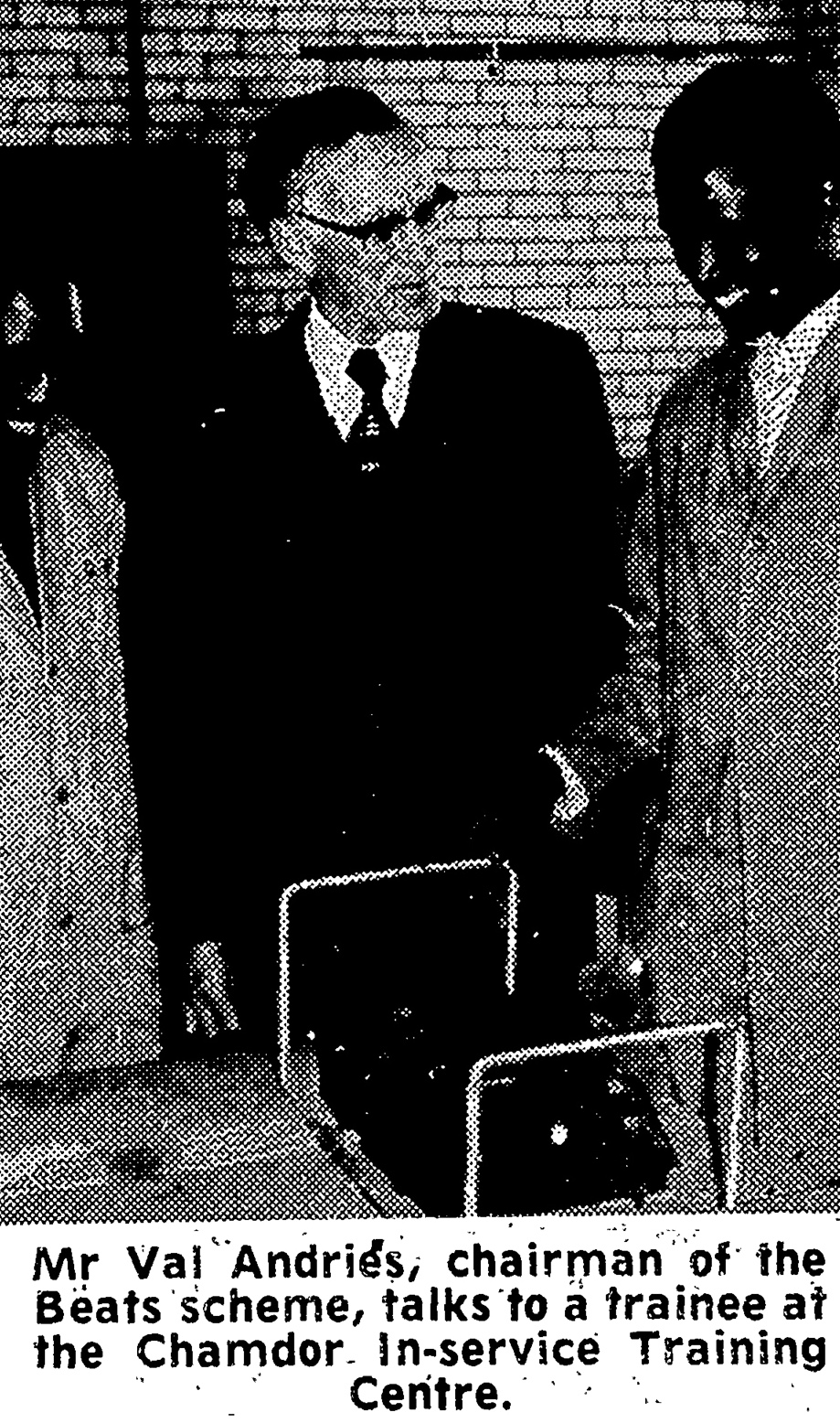
Photographs accompanying news stories offer a source of rich discursive information. I have used these pictures to show the ideologies conveyed via the visual representations, for instance, of attractive white women clerical workers sitting in front of a computer, instructed by her white male boss,19 or of developmental instruction given to a new Black recruit by a white male expert.20 The grainy black and white photographs tell their own stories of hierarchies and common sense meaning conveyed to the newspaper’s white readership about the potential of these jobs to bring different segments into computer employment.
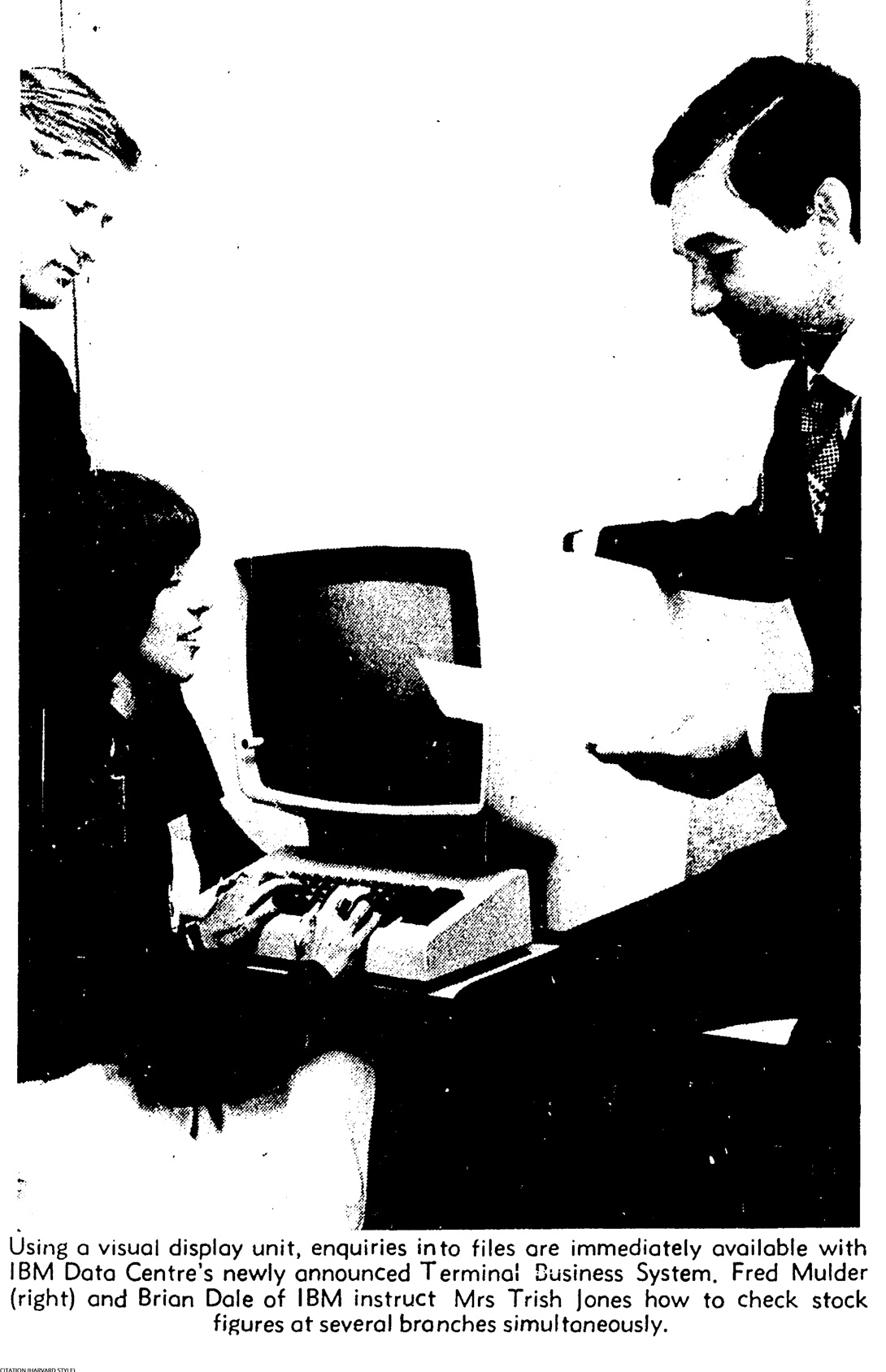
Discursively, the media predicably showed the enthusiasm for the technology and the futures it portended. The delight of advances in speed, capacity and useability filled the pages of the newspaper, even when organised protest of US computer companies, such as IBM, and its investment in apartheid South Africa, gained momentum. The stories proved indeed to its white readers that South Africa was modern and metropolitan, an explicit goal of apartheid state leaders. However, at the same time, computers appeared as an infrastructure to reproduce racial and gender segmented labour markets. Hence, digital newspaper archives prove to be a good starting point for analysing the representation of the digital transformation, particularly when archival sources are scarce.21
Fußnoten
-
1
This essay is based on: Bridget Kenny, Computing Racial Capitalism from South Africa: Computers as Infrastructure of State, Capital and Labour Relations, 1940s – 1980s, in: Gleb Albert/Julia Gül Erdogan/Michael Homberg (eds.), Worlds of Digital Labour, Leiden/Boston (Brill Publishing, forthcoming).
-
2
See for instance, the special issue of African Studies 69 (2010), Life After 30 – The History Workshop; on the tradition of social history in Wits’ History Workshop.
- 3
-
4
See Fred St. Leger, The World Newspaper 1968-1976, in: Critical Arts 2 (1981), 2, pp. 27-37.
-
5
Leger, The World Newspaper, p. 28.
-
6
Bridget Kenny, The »Shop Girl« and White Nationalism: White Working-class Women and Femininity in Johannesburg Department Stores, 1930s-1970s, in: International Labor and Working Class History (ILWCH) 104 (2023), pp. 55-76, online https://www.cambridge.org/core/journals/international-labor-and-working-class-history/article/shop-girl-and-white-nationalism-white-workingclass-women-and-femininity-in-johannesburg-department-stores-1930s1970s/FBF254138775EF3B13990C4C1D09CF0D.
-
7
Bridget Kenny, Retail Worker Politics, Race and Consumption in South Africa: Shelved in the Service Economy, London 2018, online https://swop.org.za/wp-content/uploads/2023/04/Kenny_Retail-Workers-PDF.pdf.
-
8
Kenny, The »Shop Girl« and White Nationalism, pp. 55, 65-66.
-
9
See Bridget Kenny, Coercive Technologies: Lifts, Labour and Affective Space in Johannesburg, South Africa in the 20th Century, in: Johan Heinsen/Juliane Schiel (eds.), Coercion At Work. Situating Labour History After the Global Turn (UCL Press, forthcoming).
-
10
See Bridget Kenny, Computing Racial Capitalism from South Africa.
-
11
Paul N. Edwards/Gabrielle Hecht, History and the Technopolitics of Identity: The Case of Apartheid South Africa, in: Journal of Southern African Studies 36 (2010), no. 3, pp. 619-639; Keith Breckenridge, Biometric State: The Global Politics of Identification and Surveillance in South Africa, 1850 to the Present, Cambridge 2014, p. 172; and see NARMIC/American Friends Service Committee, Automating Apartheid: US Computer Exports to South Africa and the Arms Embargo, NARMIC 1982 (https://jstor.org/stable/al.sff.document.bmdv3).
-
12
»£100,000 Robot Solves ›Maths‹ Problems«, in: Rand Daily Mail, March 18, 1946, p. 1.
-
13
Rand Daily Mail, July 11, 1958, p. 5; »New Computer,» in: Rand Daily Mail, November 13, 1958, p. 18; »Brain Tells All – And in Advance,» in: Rand Daily Mail, April 16, 1958, p. 4.
-
14
Janet Toland, Big Brother in New Zealand: Anticipating the Computer, in: Dick van Lente (ed.), Prophets of Computing: Visions of Society Transformed by Computing, New York 2022, pp. 421-456, p. 422; Michael Homberg, Digital India: Swadeshi-Computing in India since 1947, in: ibid., pp. 279-324, p. 289.
-
15
Stuart Hall, The Whites of Their Eyes: Racist Ideologies in the Media, in: Stuart Hall, Charlotte Brunsdon (ed.), Writings on Media. History of the Present, Durham, NC 2021, pp. 180-184.
-
16
»Appointments,» in: Rand Daily Mail, November 25, 1969, p. 11; »Appointments,» in: Rand Daily Mail, November 6, 1969, p. 12; and see »Appointments,» in: Rand Daily Mail, November 25, 1969, p. 11.
-
17
»Electronics field offers big grants,» in: Rand Daily Mail, November 9, 1976, p. 2.
-
18
Kenny, Computing Racial Capitalism from South Africa.
-
19
»Computer power on your desk,» in: Rand Daily Mail, January 30, 1975, p. 38.
-
20
»Electronics field offers big grants,» in: Rand Daily Mail, November 9, 1976, p. 2.
-
21
In short, while digital newspaper archives are not a source to be used wholly on their own, I find them useful in a context of limited archival evidence to sketch a timeline of phenomena and when they changed within public discourse. Against this timeline, researchers can then look for more concrete evidence from complementing sources.
Lizenz