How to Manage a National Economy
The Cybersyn Operations Room in Allende’s Chile
Steckbrief Quelle
Stafford Beer, "Cybernetics Part 3," The University of Manchester- Date
- 1974 (original version), 2007 (digital version by Catalina Ossa and Enrique Rivera)
- Archive
-
personal archive of Raúl Espejo
(https://www.youtube.com/watch?v=g6Fc3BqcRNU)
When Chilean president Salvador Allende came to power in September 1970, he and his government recognized that the success of his socialist program depended on the success of his economic program. This included nationalizing Chile’s most important industries and raising industrial production levels. However, Allende had also won the presidency with a commitment to upholding Chile’s democratic institutions and preserving civil liberties. He called this peaceful and democratic approach to socialist change the »Chilean road to socialism.«
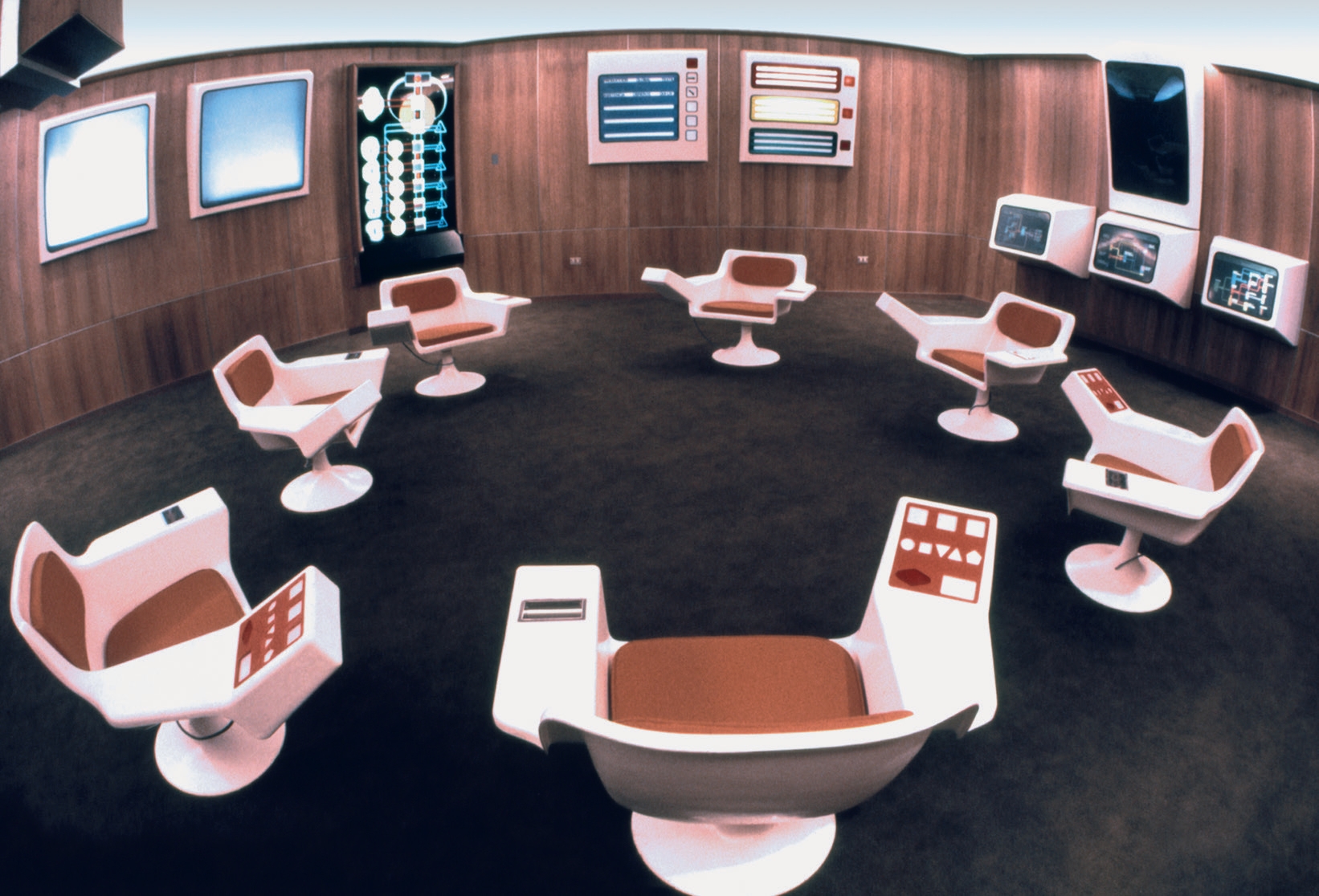
This article examines this crucial period through the lens of the history of computing. It argues that computers and cybernetic systems formed part of Chile’s innovative approach to political change. From 1971-1973, Chile embarked on a project to build a computer system for economic management that would help the government run the nationalized sector of the economy. The history of the system, known as Cybersyn, demonstrates how notions of democratic participation were embedded in its design. This is perhaps best seen in the design of the Cybersyn operations room, which the government envisioned as a futuristic space for data-driven decision making.1
Managing the Revolution
By the end of Allende’s first year in office, it had become clear that managing the growing nationalize sector presented substantial challenges. The government had not instituted a clear and consistent procedure for bringing industries under state control.2 It was also fighting a »battle of production« to raise or at least maintain production levels, which became increasingly difficult after the U.S. government implemented an »invisible blockade« of Chile to prevent communism from spreading in the region.3 Such forms of economic hostility prevented Chilean factories from importing needed equipment and spare parts.
The government placed its nationalization effort under the control of the Corporación de Fomento de la Producción (State Development Corporation, CORFO). It had no experience managing the most important industries in the economy. However, the general technical manager of CORFO, a young engineer named Fernando Flores, had an idea. He remembered reading a work in the field of management cybernetics written by a British cybernetician named Stafford Beer. The term »cybernetics« emerged after World War II to refer to the interdisciplinary science of feedback and control that drew from fields such as mathematics, engineering and neuropsychology to study the behavior of biological, mechanical and social systems and how to regulate them. Beer, a British management consultant, applied these concepts to the management of firms and had done so quite successfully. His work sought to transform industries into self-regulating systems that could respond quickly to dynamic changes in their environment. Flores saw management cybernetics as a way for Chile to increase its control of the industries being brought under state control, while also raising levels of production nationally. He invited Beer to come to Chile to help the government improve its economic management capabilities.4 Beer accepted the invitation and arrived in Santiago on the celebration day of Allende’s first year in office.
The Vision: Project Cybersyn
This collaboration gave rise to a new experimental system for economic management that built new communication channels, tools for data collection and analysis, and environments for decision-making. In less than two years, a multidisciplinary project team bridging Chile and England established a network of telex machines that spanned Chile’s long, narrow geography and connected the upper reaches of the government to the newly nationalized factories. The telex machines would transmit data from the factories to a central computer center in Santiago. The team developed a new suite of custom software that applied statistical methods to this data to predict production trends and raise alarms about potential economic problems. The team also started working on an economic simulator that would allow policymakers to test the effects of different policy decisions. This prototype simulator was designed to give those in government a means to play with different economic policies and, through play, better understand how different parts of the economy fit together and shape one another.5
Finally, team members created a prototype operations room that they hoped to re-create in different spaces throughout the country. The room would update decisionmakers on economic activity by displaying potential emergencies detected by the software. It would also display visualizations to help occupants grasp the dynamics of Chilean economic activity quickly.
The room they eventually built looked like something out of a science-fiction film. Four components – the telex network, statistical software, economic simulator and operations room – collectively formed the Cybersyn project. As a portmanteau of cybernetics and synergy, the project name recognized both the interdisciplinary science that provided its conceptual core and that the system as a whole was more than the sum of its component parts. The Cybersyn operations room is the only subproject of the four that involved industrial and graphic design professionals, including designer Gui Bonsiepe, who had studied and taught at the famed design school Hochschule für Gestaltung Ulm (HfG Ulm) in Germany.6 In addition, the room is the only subproject with ties to the institutional history of Chilean industrial design.
The Project Cybersyn grew out of the Flores-Beer connection. However, the connection between Flores and Bonsiepe also proved central to the design of the Cybersyn operations room. In addition to his role as general technical director of CORFO, Flores served as the president of the Comité de Investigaciones Tecnológicas de Chile (State Technology Institute, INTEC), a government research and development center charged with improving Chilean industrial capabilities. While at INTEC, he used his power to create the Área de Diseño Industrial (Industrial Design Area), Chile’s first state industrial design group, which he placed under the leadership of Bonsiepe, whom he had met through a mutual friend.7
The Liberty Machine: Technology and Design in the Practice of Governance
The operations room bears the hallmarks of Bonsiepe’s work and the approach to design he helped develop at HfG Ulm. This includes bringing insights and methods from science to the practice of design, embracing the development of local solutions to industrial problems, viewing design as a political act and recognizing how design can allow people to imagine and build the world they want to inhabit.8
The room’s explicit connection to the advancement of Chilean democratic socialism and goals – such as the improvement of living standards for poor and working-class Chileans and Chile’s forging of its own political path – also aligned with Ulm School commitments to democracy, self-determination, autonomy and the improvement of the economic and social status of the marginalized. Intellectually, the design of the room drew from fields such as cybernetics, semiotics and system theory, just as the Ulm School had.9 As Bonsiepe later observed: »There are not many examples of the convergence between social responsibility, advanced technology and design.« However, the Chilean cybernetic management center »can be considered an exception.«10
The room’s design also reflects Stafford Beer’s ideas. Beer described the room as part of his idea for a »Liberty Machine.« Beer’s conceptual machine offered governments a way to combat bureaucracy by making information the basis for government decisions.11 In 1971, he described it as a series of operations rooms that received information from different areas of the government in close to real-time. The rooms would use computational power to determine the relevance of the collected data and communicate their importance to decision makers. The rooms displayed data on a series of television screens and functioned as spaces where decision makers could look to the future and use recent data as the basis for planning. These data would arrive at the room through new communication and computational channels created to minimize lag. Given the large quantities of data that such a system would potentially collect, Beer stressed that any data collected would have to be attenuated and aggregated thoughtfully, so that the information displayed in the room did not go beyond the limits of human comprehension.12
Beer believed that understanding complex systems and their regulation would improve government operations. He also viewed the control chair and screen configuration for the operations room as a potential means for searching for information from the privacy of one’s home; his description from the early 1970s bore a remarkable similarity to how we would use the internet twenty years later. In short, the room became part of how Beer envisioned putting science and technology into the hands of the people, either through personal use or through democratic processes of governance.
Command and Control: The Operations Room and its Cybernetic Design
Architectural constraints pushed INTEC designers to settle on a hexagonal room that allowed the placement of visual displays on every wall, except for the wall at the entrance.13 The room had wood paneling, brown carpeting, overhead lighting and indirect lighting along its perimeter. Within the room, the designers placed seven fiberglass chairs in an inward-facing circle. The choice of an odd number prevented tie votes while the circular arrangement gave all occupants equal status. The chairs swiveled easily on their base and were large and comfortable, design decisions that encouraged conversation and allowed occupants to view the data displayed on each wall.
One wall contained four display screens known as »Datafeed.« These screens displayed information about the Chilean economy, from the total industry down to individual factories. The industrial flow diagrams, production data, economic indicators, photographs and lists of known problems helped occupants quickly understand the status of different industrial processes and draw connections.
Visitors could change the information on the four Datafeed displays by using a series of geometric buttons located on the armrest of each chair. The wires running under the floor connected these buttons to a series of slide projectors placed on racks behind the wall. A reset button, also located on the bottom row, restarted the process. A person located behind the wall maintained the slide projectors and had their own set of button controls. The maintenance person used an intercom to communicate with the people in the room.
Creating an interface based on ten geometric buttons, rather than a traditional keyboard, made the room accessible to those without typing skills, such as workers (or members of the government elite who had secretaries). However, this design decision also replicated the Cold War desire to control the outside world by pushing a button. As media scholar Rachel Plotnick writes in her book Power Button, push buttons seem to offer an »effortless technical experience« and a form of command whereby a small movement of the hand can »direct anyone or anything to submit to their will.«14 As a design decision, these buttons visually furthered the mystique of the room as a space for control. However, the interface was difficult to navigate in practice. Moreover, the final design lacked a key feature of the button-pushing experience, namely, feeling its downward motion. The team encountered difficulties in acquiring the necessary component parts that would give the buttons a raised profile.
The algedonic panels connected the room to the daily economic data that the Cybersyn system collected from the state-run factories by telex and were entered in the statistical software for analysis. This software generated an alert whenever a production index fell outside an acceptable range of values. The members of the Cybersyn team initially communicated these alerts to the appropriate enterprise manager. However, they would communicate the alert to higher levels of management if the enterprise manager could not solve the problem within a given period. The alert would work its way up the management hierarchy. It would eventually appear in the room printed on a piece of acrylic tape that the maintenance person would place on one of the two algedonic panels. This would make the alert visible to the room’s occupants and shape their discussion.
Beer continued to provide feedback to the design team as the work progressed. For example, in March 1972, he made it clear that the »Operations Room should be thought NOT as a room containing interesting bits of equipment BUT as a control machine comprising men and artifacts in symbiotic relationship.«15 However, he did not provide the team with a clear list of requirements, as was typical for the design process.
Photographs of the room frequently show the space without people, which makes grasping its scale difficult. An image of an unnamed woman seated in the operations room in the early 1970s illustrates its considerable size, as well as the width of the chairs and the size of the cabinets. Interestingly, the surviving photos that show people in the operations room feature women and children. This visual record runs counter to the design itself, which was built to encourage masculine forms of expression, such as thumping the geometric buttons on the armrest when an occupant wished to express a point.16
The Cybersyn room is perhaps best known for the work completed by the INTEC industrial design team. However, the project also benefited from the labors of three female graphic design students from the Catholic University School of Communications. The students worked with Bonsiepe outside INTEC and took on different design projects under his supervision. These three women, Eddy Carmona, Jessie Cintolesi and Pepa Foncea worked with a fourth design student, Lucía Wormald, on projects such as the design of the INTEC logo.
Foncea recalled that when Bonsiepe arrived in Chile, in the late 1960s, he arrived precisely at a moment when design could become more meaningful.17 Chile was in the middle of a university reform movement that called for, among other things, making the university more socially aware, connecting the university to the surrounding community and directing university activities toward solving national problems. The Catholic University had traditionally been a space for the wealthy elite. However, the context of the reform movement pushed students and leadership to reconsider how the university could help the country achieve larger social goals, considerations that shaped the path of Chilean political history.
Members of the Movimiento de Acción Popular Unitaria (Movement for Unitary Popular Action, MAPU) would politically align themselves with the parties of the Unidad Popular coalition and contribute to Allende’s victory in 1970.
The graphic design students Foncea, Carmona, and Cintolesi created the data visualizations that appeared on the Datafeed screens, and in the process created a visual language that gave meaning to shapes of different sizes and colors and helped make the data displayed more understandable. They created these visualizations by hand with a painstaking process of cutting and gluing pieces of colored paper onto black cardboard. They then added the text by using stencils and white paint. These paper visualizations were then photographed and converted into slides, which were then back projected on the Datafeed screens to simulate computer monitors.
Like the maintenance person located behind the wall of the room, the four female designers provided invisible labor that helped the room appear to be automated. Foncea recalled having a discussion with Bonsiepe about eventually hiring a graphic production team to scale the process of cutting, pasting and stenciling images for display.
The Legacy
Construction of the room began in 1972. It was unveiled as a working prototype at the end of the year, during the peak of the Chilean summer. Allende visited the room on the last day of December, sat in one of the chairs and pushed the buttons. Even though the heat of the summer day had pushed the electronics outside their tolerance,18 Allende communicated that he wanted the team to keep going. Allende asked Bonsiepe to move the room to the Presidential Palace in early September 1973.
That never happened – the military coup took place shortly after. Work on the project stopped abruptly once the military assumed power. The military coup, and the violence that followed, created a rupture in Chilean technology history, stopping projects, disbanding teams and making it impossible for the technology projects the Allende government had begun to have the same political significance as before. Project Cybersyn, thus, was never completely implemented. However, it remains one of the most ambitious projects in the history of cybernetics. While Latin America does not figure prominently in most mainstream computer histories, the Cybersyn story illustrates the value of expanding our understanding of where technological innovation occurs. Different historical circumstances can produce alternative technological possibilities and provide motivation for considering how computing might be otherwise.
Fußnoten
-
1
This article is edited from Eden Medina, How to Manage A National Economy: The Cybersyn Operations Room, in: Hugo Palmarola/Eden Medina/Pedro Ignacio Alonso (eds.), How to Design a Revolution: The Chilean Road to Design, Zürich 2024, pp. 244-273.
-
2
Peter Winn, Weavers of Revolution: The Yarur Workers and Chile’s Road to Socialism, New York 1986.
-
3
Cf. Barbara Stallings, Class Conflict and Economic Development in Chile, 1958-1973, Stanford 1978.
-
4
Fernando Flores, Letter to Stafford Beer, 13.07.1971, Box 55, Stafford Beer Archive, Liverpool John Moores University Special Collections & Archives.
-
5
Eden Medina, Cybernetic Revolutionaries: Technology and Politics in Allende’s Chile, Cambridge, MA 2011; Stafford Beer, Brain of the Firm, New York ²1981.
-
6
René Spitz, HfG Ulm. Concise History of the Ulm School of Design, Zürich 2014; Lara Penin (ed.), The Disobedience of Design: Gui Bonsiepe, New York 2022.
-
7
Bonsiepe arrived in Chile in 1968, after the HfG Ulm closed. Once in Santiago, he began mentoring a group of four students from the University of Chile: Guillermo Capdevila, Rodrigo Walker, Fernando Shultz and Alfonso Gómez. These students followed Bonsiepe when he accepted a teaching position at the Catholic University School of Engineering. When Bonsiepe accepted the position at INTEC, they followed him again and joined the new Industrial Design Area. Bonsiepe expanded the group further by recruiting several recent graduates from the Ulm School. Collectively, this group would develop nearly twenty products for the Allende government, including the design for the Cybersyn operations room. Outside INTEC, Bonsiepe worked with a team of graphic designers who created visual elements for a range of projects, including the graphics projected on the operation room’s central data displays.
-
8
For an introduction to Bonsiepe’s writings, see Frederico Duarte, Nostalgia is Futile – Our Future Starts Now, in: Penin (ed.), Disobedience, pp. 3-10.
-
9
Gui Bonsiepe, The Relevance of the Ulm School of Design Today, in: Penin (ed.), Disobedience, pp. 26-32; idem, The Invisible Facets oft he HFG Ulm, in: Design Issues 11/2 (1995), pp. 11-20.
-
10
Gui Bonsiepe, Opsroom: Interface of a Cybernetic Management Room, in: Penin (ed.), Disobedience, p. 381.
-
11
Stafford Beer, The Liberty Machine: Can Cybernetics Help Rescue the Environment?, in: Futures 3/4 (1971), pp. 338-348.
-
12
Idem, Designing Freedom, Toronto 1993, p. 69.
-
13
For a detailed description of the operations room design, see Grupo de Proyecto de Diseño Industrial, Diseño de una sala de operaciones, in: INTEC 4 (1973), pp. 19-28.
-
14
Rachel Plotnick, Power Button: A History of Pleasure, Panic, and the Politics of Pushing, Cambridge, MA, 2018, p. xvi, p. 227.
-
15
Stafford Beer, Project Cybersyn, March 1972, box 60, Stafford Beer Collection, Liverpool John Moores University.
-
16
For more on the gendered aspects of the room’s design, see Eden Medina, Cybernetc Revolutionaries: Technology and Politics in Allende’s Chile, Cambridge, MA 2011, pp. 125-128.
-
17
Carmen (Pepa) Foncea, interview by the author, Santiago, Chile, July 25, 2006.
-
18
Roberto Cañete, telex to Stafford Beer, January 3, 1973, box 66, Stafford Beer Collection, Liverpool John Moores University.
Lizenz